Showing posts with label First World War. Show all posts

Tuesday, 8 March 2016

International Women's Day

In recognition of International Women's Day, we'd like to celebrate two of our local women who pushed through stereotypes and societal restrictions. Both were in an era when their actions would have initially attracted much gossip, comment and criticism. Their names are Agnes Lawson and Susan Colpitts.

Mrs Susan Colpitts of Heppleholme Farm in Winchester, South Carnamah

Agnes Scott Lawson / Sharp

In 1914 an entrepreneurial Agnes Lawson, who ran a dairy in Scotland, financially assisted her brother Jack to buy one of the Midland Railway Company's Ready-Made Farms at Winchester. Two years later she immigrated to Western Australia and was soon in touch with the company about buying a farm of her own.

The Midland Railway Company couldn't even contemplate the idea of selling a farm to a woman. The concept was absurd! They suggested that the farm be in her brother's name, however, she refused point blank to put her capital into his or anyone else's name. Much correspondence followed but the company held firm on their position. A women couldn't own a farm. How would she run it? Could she ever pay it off?

Poor Agnes. The irony is that she wasn't poor at all. This single 29 year-old woman had worked and saved enough money to pay the deposit on a farm! She would actually have been the envy of many men aspiring to be in the same position. In the end the hand of the company was forced by fear. They became worried that if they didn't sell Agnes a farm that her brother Jack would leave. This would be a big backward step for the Winchester settlement they were trying to grow and promote.

On 3 November 1916 Miss Agnes Lawson signed the dotted line to purchase the 465 acre Lot M922 in Winchester. The farm came with a house and 148 acres of cleared and cropped land. Payable by installments, it came at a cost of £2,150. Using the Reserve Bank of Australia's Pre-Decimal Inflation Calculator, this would be approximately $210,000 in today's money.

But how did Agnes fare? Did the farm fall into a big heap under the control of a woman? Not quite. In fact, for a while Agnes was one of only two Ready-Made Farm settlers who were managing to pay their repayments on time!

Agnes found love a little later in life and in 1922 married George Sharp. He was returned soldier from the First World War who had taken up farming in Carnamah. Their first child Nancy died at the age of two months but was followed by two more children, Agnes and Charlie. Sadly, her husband's war injuries took their toll and George passed away when their son Charlie was only three weeks old.

Agnes raised her children, ran the farm and also established a local dairy.

She was a regular and very diverse exhibitor at Carnamah's annual agricultural shows. During this era the sections of the show were typically considered men's classes such as livestock and grain or women's classes, such as cooking and sewing. Not for Agnes!

In 1928 she won 1st prize for Scones and 2nd for Sheaf of Early Variety Grain. Then in 1929 she took out both 1st and 2nd for Jersey Cow while winning 2nd for Butter and Scones! As the years went on, and she improved her herd of cattle, she would win most of the prizes in the Cattle section. She also participated in the Carnamah District Agricultural Society's activities and in 1934 came equal 2nd in their Fallow Competition.


Mrs Susan Catherine Maria Colpitts

In 1913 Susan Colpitts immigrated from South Africa to join her husband Jack. They settled on a Ready-Made Farm at Winchester, which they named Heppleholme after the middle name of Jack's aunt. They'd barely been on the farm six months when the First World War broke out. Jack soon enlisted in the Australian Imperial Force and left for the front, serving in both Turkey and France.

Susan took over the running of the farm and its further development. She also boosted the farm's income by securing contracts to do work on the Midland Railway Company's unsold farms in Winchester and Coorow. Her place as a farmer, not just a farmer's wife, was firmly grounded when in 1917 she was named an Inaugural Vice President of the Winchester-Carnamah branch of the Farmers & Settlers' Association.

During the war Susan also worked tirelessly to raise money for the Red Cross and other organisations that worked to support and care for troops serving in the war. One example of this was as secretary for Winchester farmer Lou Parker's candidature in the Lazy Man Competition being run in Three Springs. From this one instance alone she raised £131, which in today's money would be almost $12,000.

Susan expected her husband home by May 1919 but four months went by and he hadn't arrived. It turned out he'd been granted leave to observe farms and agricultural practices in England but had failed to let her know! He did, however, finally arrive home just before Christmas - probably to a very happy but annoyed wife!

Susan and her husband then ran their farm together, as by this time she was the experienced Australian farmer - having been on their farm for four years longer than her husband. For a few years during the 1920s Susan also operated Winchester's telephone exchange and post office from their home.


For more information, please see:


International Women's Day occurs on 8 March each year and is a day to celebrate the social, economic, cultural and political achievement of women. It's also a day to be aware that progress has slowed in many places across the world and that urgent action is needed to accelerate gender parity. For more, see www.internationalwomensday.com

Sunday, 27 December 2015

MMXV: Features of 2015


"Carnamah Historical Society and Museum's website and, in particular, it's Virtual Museum and Biographical Dictionary are one of Australia's biggest online success stories." - Museums & Galleries NSW


First World War

April marked the centenary of the Anzac landings on the Gallipoli Peninsula in Turkey. We marked the occasion with the launch of a new virtual exhibition on the First World War as well as a physical exhibition within our museum (the latter being in partnership with the WA Museum). A request to say a word or two at Carnamah's dawn service quickly escalated into us being handed the baton to give the official address, and for such an auspicious anniversary.

Links:  First World War virtual exhibition  |  Transcript of Anzac Day speech 

"I used your... virtual museum exhibition in my year 7-10 classes at Carnamah DHS today as a lead up to Anzac Day. The students were thoroughly engaged by the stories particularly as they featured local soldiers and names they could relate to. It provided a great springboard for some fantastic discussion. Thanks for such a fantastic and timely resource."

www.carnamah.com.au/first-world-war
Major Jack Colpitts of Heppleholme Farm in Winchester, South Carnamah

Macpherson Homestead

It's been a year of highs and lows for the old and wonderful Macpherson Homestead.


We were delighted to welcome a special group of visitors during the year, which included Oriel Green (nee Bartlett), her sisters and a number of their relatives and friends. Oriel spent a portion of her childhood in Carnamah and Three Springs during the 1930s but what made the visit more momentous was that her family are believed to be Aboriginal descendants of the Macpherson family.


Another high was our first steps toward the homestead hosting primary school excursions. Our thanks to Ignite Your Audience for their work so far and to the Three Springs Primary School for being our enthusiastic test-subjects!


Sadly the conserved ruins of the bakehouse at the homestead began to rapidly and suddenly deteriorate in October. Huge cracks spread through the walls and a large section began to collapse. However, we're pleased to report that the collapsed section has been restored and the remainder has been solidified and conserved to ensure the ruin will continue to stand strong.


www.carnamah.com.au/homestead


Western Australian Heritage Awards

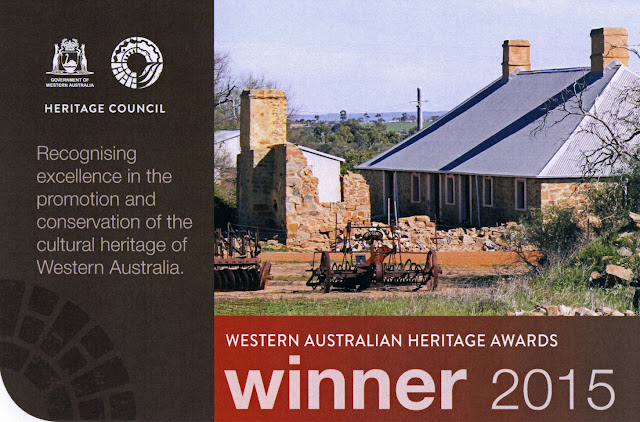
For the second year in a row, we were a finalist in the community organisation category of the WA Heritage Awards and were stoked to be named this year's winner.

"Carnamah Historical Society & Museum uses cutting-edge technology to engage with and promote the heritage of, not only their own and neighbouring districts, but also the State. Impressively, the society has established a virtual volunteering platform that has engaged 7,000 people with online heritage projects, which, in turn has provided a valuable resource for historians and the State."

http://www.blog.carnamah.com.au/2015/04/2015-winner-WA-heritage-awards.html


Australian Curriculum Resources

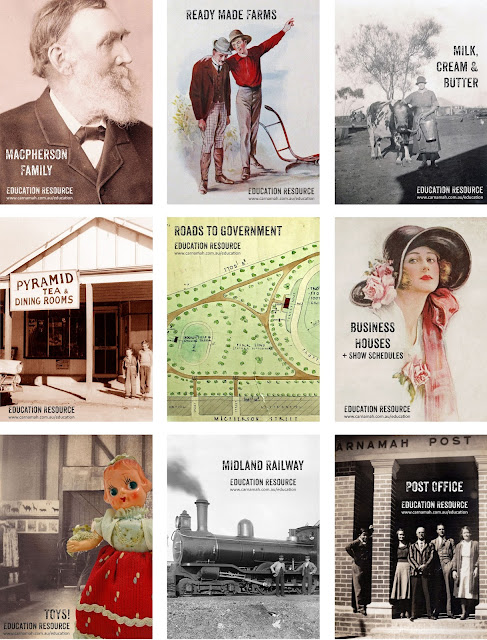
For a few years we had been working hard, in partnership with Ignite Your Audience, to create a suite of Australian Curriculum education resources. Our completed range of nine resources, which relate to primary years, were promoted at the History Teachers' conference in Mount Lawley and the third History TeachMeet in Peppermint Grove. The resources are a little different - as they can be used with school visits to our physical museum or from classrooms anywhere in Australia (with our virtual museum and other online content).
We've received a lot of favourable comments, including glowing feedback from the National Gallery of Australia in Canberra! We were especially delighted when our resources received a Highly Commended in the Interpretation, Audience and Learning Engagement category of the Museums and Galleries National Awards.

www.carnamah.com.au/education


Museums and Galleries National Awards

The Museums and Galleries National Awards, or MAGNAs, are conducted annually by Museums Australia and are held during the national museums conference. This year's conference was in Sydney and we had a few reasons to go. Both our education resources and our virtual volunteering program were short-listed in different categories and we're pleased to say they each received a Highly Commended. Not a bad effort considering the competition was mostly state and national institutions!


http://www.blog.carnamah.com.au/2015/05/wa-parliament-and-two-highly-commended.html

 
In the Media and in Parliament!

Our achievements of recent years were featured in the Museums Australia magazine, on the blog of Museums & Galleries NSW and in the Heritage Council of WA's Heritage Matters magazine. 
We were also honoured in the lower house of the Western Australian Parliament on 21 May 2015 when Shane Love, the MLA for Moore, spoke about our endeavours and successes.


Thank you

Our thanks to you for being part of our 2015 - whether it was online to our blog, Virtual Museum or Biographical Dictionary, or as a physical visitor to see our history and heritage on the ground in Carnamah.

We'd also like to thank those who supported us during the year. Special thanks are due to all of our virtual volunteers, to project partners atWork Australia and the North Midlands Project, and to financial supporters the Department of Culture and the Arts (DCA) and the Anzac Centenary Local Grants Program.

If you're ever in Carnamah, we invite you to stop by:

Tuesday, 19 May 2015

The Anzac Centenary in Perenjori

In the lead up to Anzac Day we assisted the Shire of Perenjori in identifying their local men who had served during the First World War. Plaques containing the names and details of the district's servicemen were added to a wall at the Perenjori War Memorial and on Anzac Day a bronze sculpture of the rising sun badge was unveiled.


The 16 men from Caron, Latham and Perenjori were:


The names of seven of the above men had already been well remembered. Their surnames label Fowler, Russell, Livingstone, Timmings, Hesford and Smith streets plus Hirschauer Road in the Perenjori townsite.


Photographs kindly provided by the Shire of Perenjori.

Saturday, 25 April 2015

The Anzac Centenary in Carnamah

Amid a fresh east wind and before a crowd of a few hundred, Carnamah continued its annual tradition of holding an Anzac Day dawn service at the Carnamah War Memorial. We were honoured to provide the address, of which a summery is below.


Each Anzac day large numbers of Australians gather at war memorials and other sacred sites to pay tribute and utter the words Lest We Forget. But... have we forgotten? Who are we remembering? Acknowledging sacrifice, although a worthy endeavour, isn't quite the same thing as remembering individuals. Those who died during the First World War were sons, fathers, husbands, brothers, nephews, cousins and/or friends. They had names, jobs, interests and aspirations. Despite changes in the world over the past 100 years, their lives weren't really that different to our own.

Let’s pause on that for a moment though, and jump back to 1914…

When the First World War broke out, Carnamah was a much smaller place than it is today. The Macpherson family had been here for over 45 years, a few others families for about a decade and the first settlers to take up Ready-Made Farms had just arrived.

Carnamah had a small one-teacher school which was under the management of 25 year old Alick McLean who, like many in Carnamah, was a Scottish immigrant. An Education Department inspector described him as "Inexperienced but eager to improve. A Good Teacher." He was granted leave from teaching towards the end of 1914 to allow him to enlist in the Australian Imperial Force, or A.I.F. He was 6 feet ¾ inches tall, weighed 164 pounds (which is 74 kilograms) and had blue-grey eyes, light brown hair and a fair complexion.

After less than a month of training at Blackboy Hill, on the outskirts of Perth, Alick departed from Fremantle on 2 November 1914. After further training in Egypt he was part of the infamous landing at the Gallipoli Peninsula in Turkey - on this day 100 years ago. His battalion landed while it was still dark. One of his comrades thought he had been shot, possibly in the arm and headed for the beach. Whatever did happen, he died and was never seen again.

Coorow farmhand George Bell also took part in the landing at Gallipoli and was shot in the thigh. He was bandaged by his comrades but had to be left behind when they were forced to retreat. He was listed as missing in action and it was hoped he'd been taken a prisoner of war. This was hoped as it meant he might still be alive. His aunt Mrs Janet McGill, who also lived in Coorow, appealed to his comrades for any information but sadly it was in vein. Four years later his body was found and it was ruled that he too had been killed in action at Gallipoli on 25 April 1915. 

Carnamah labourer John Davern served at Gallipoli after the landings but only for six days. He was shot in the thigh and on retiring his lieutenant said they'd send stretcher bearers for him. Unfortunately none came and he laid there until the afternoon when he was captured by Turkish forces. He was a prisoner for the remainder of the war and kept variously in hospitals, prisons and churches across Turkey. At one hospital his wounds were never dressed and they turned black. At another the treatment was exceptional and after five months his wounds finally began to heal. At the end of the war he was repatriated to England and later returned to Australia.


Left: Bill Laundy of the Carnamah Lions Club
Right: Andrew Bowman-Bright of the Carnamah Historical Society & Museum

It’s also worth remembering that Anzac Day isn't just about Gallipoli or the First World War. It is a day to acknowledge and remember the service and sacrifice of all men and women in all conflicts. On the war memorial in Carnamah are 17 names.

We remember Carnamah railway fettler Aeneas Murray, labourers Sydney Brooks, James Keenan and Edward Statham, and two men whose full names have been lost to the passages of time and which no one can positively identify – E. Kennedy and W. Regan. We also remember three men whose names were omitted from the memorial, either unintentionally or because at the time Winchester was seen as a district of its own. They are Winchester farmer Major Christopher Hoskyns-Abrahall, Winchester farmhand Charles Vernede and clearing contractor Herbert Larkin.

From the Second World War we remember Carnamah bank teller Bernie O’Hara, Coorow farmhand Spanner Spencer, former Carnamah policeman Maurie Plunkett, Carnamah farmhands George McGowan and James Murphy, Waddy Forest farmers Jim Morcombe and Keith Morcombe, and Carnamah mechanics Bill Clark and Ivan Johnson.


The Carnamah Historical Society & Museum, with support from Lotterywest, is a partner in the WA Museum’s Remembering Them project, which is to stage small exhibitions on the First World War across regional Western Australia. The exhibition was on show at the community breakfast at the Carnamah Bowling Club and will continue at our museum.

We have also created a virtual exhibition on the First World War, which can be seen at www.carnamah.com.au/anzac. This was made possible thanks to the Anzac Centenary Local Grants Program, Bankwest and the North Midlands Project. Special thanks are also due to Reg Ellery for his photo-editing contributions.

37 men from Carnamah and Winchester served during the First World War with ten never returning home.

Lest We Forget.

Tuesday, 11 November 2014

Remembrance Day: Lest We Forget

A Remembrance Day service was held at ANZAC Cottage in the Perth suburb of Mount Hawthorn on Sunday. The front lawn of this quaint little cottage was covered in small white crosses. Some were marked to remember individuals lost and remembered while others were blank to remember the many other servicemen and women who have fought in wars for Australia. We contributed three crosses to remember the lives and service of three local men...


For more information on the lives and service of the above three men, have a read of their entries in our Biographical Dictionary of Coorow, Carnamah and Three Springs:


For a fuller list of local men who served in the two world wars, please see our online reproduction of the Carnamah Honour Roll.

Thursday, 6 November 2014

Remembrance Day, the forgotten and ANZAC Cottage

At 11 a.m. on 11 November 1918 the guns of the Western Front fell silent after four years of continuous warfare. This marked the end of fighting during the First World War and has been observed ever since as a time to remember those who died in the war.

Although we often utter the words Lest We Forget, the sad truth is that many people were forgotten. The Carnamah War Memorial was erected many years later in 1929 and due to the passing of time or viewing the district very narrowly, the names of three men were never included. They were:

  • Christopher H. Hoskyns-Abrahall, farmer of Winchester. He was Major and 2nd in Command of the Portsmouth Battalion of the Royal Marine Light Infantry. After leading an attack at Gallipoli he died of wounds on a hospital ship in 1915.
  • Herbert V. Larkin, clearing contractor of Winchester and Carnamah. He served with the Australian Imperial Force's 6th Tunnelling Company and died in 1916 from measles and bronco pneumonia.
  • Charles W. E. Vernede, farm manager of Winchester. He served with the 48th Infantry Battalion in France and was killed in action in 1916.


Remembrance Day is being commemorated at ANZAC Cottage in the Perth suburb of Mount Hawthorn with a Field of Remembrance. The field will consist of white crosses dedicated to fallen service men and women. We will be contributing three crosses for the three forgotten men from the Carnamah-Winchester district.

Anyone is welcome to attend ANZAC Cottage's Remembrance Day service for a gold coin donation. It's also a great opportunity to have a look at the cottage built in a day as a memorial and home for a returned serviceman.

When:  10.45 a.m. on Sunday 9 November 2014 
Where:  ANZAC Cottage, 38 Kalgoorlie Street, Mount Hawthorn

Friday, 19 July 2013

Peace Day Celebrations in Carnamah in 1919

94 years ago the people of Carnamah gathered together to celebrate Peace Day - the official end of the First World War. The day comprised of mostly horse and children's races and was followed by a dance in the evening. Below is a full report on the day's festivities from The Moora Herald and Midland Districts Advocate newspaper.


Friday 25 July 1919

Carnamah Notes [From Our Own Correspondent]

"One of the brightest days ever held at Carnamah was celebrated on the ever-to-be-remembered Peace Day, July 19, and the committee must indeed feel pleased with themselves over the success of the meeting. One of the chief items of the day was the race for the fine Cup presented by the committee to the winner of the Peace Cup Race which resulted in it going one of our neighbours of Winchester, Mr L. Parker. After one of the most exciting race seen for some time on our course resulted in a victory for Mr L. Parker's horse Winchester. The winner received a great reception when he returned to the scale.

Children's races opened the proceedings in the morning. Mr T. Davieson, who had charge of the horse racing events, started the ball rolling with the novelty race, and the racing was all that could be desired. After a good afternoon's outing a dance was held in the evening and one thing that the people of this district can boast of is, the music of their district., which is indeed well worth travelling a few miles to dance to. Miss Davieson and Mr C. Robertson played the piano, assisted by Mr S. Sturtbridge and Mr J. Clinch on their violins and Mr H. Berry on the flute. Great credit is indeed due to the musicians who helped to make the evening such a success. Dancing was indulged in until the early house of the morning. During the evening the president of the race committee (Mr J. Lang) presented the cup to Mr Parker, and, after a brief address by the chairman in making the presentation to Mr Parker stepped onto the platform, to receive it. Mr Parker expressed his great pleasure in receiving such a memorable cup from the committee as it was only once in a lifetime that such a cup would be competed for.

Novelty Race - Walk once round, trot once round, gallop once round the course.
     Mr D. Macpherson's Charcoal. Won by a neck.
     Other starters - Birdie, Dandy, Canary, Rusty Wheat, Jun Jun, Grianaig.
Peace Cup - Cup presented by committee to winner, with 5s sweepstake.
     Mr L. Park's Winchester 1. Won by a head.
     Other starters - Kitty, Younga, Wild Joe, Canary, Chestnut Canary, La Carnamah
Hack Race - Mr D. Macpherson's Wild Joe 1; L. Parker's Windy 2. Won by one length.
     Other starters - Birdie, Grianaig, Chester, Younga, Carnella.
Farmer's Race (for farm horses only) -  Mr J. Rooke's Rusty Wheat 1.
     Other starters - Jun Jun, Scoty, Billaroo.
Hurry Scurry - Mr T. Bonham's Birdie 1. Won by a head.
     Other starters - Carnella, Younga, Lady Bird, Chestnut Canary, Chester.
Trotting Handicap - Mr D. Fitzsimmon's Dandy 1.
     Other starters - Grianaig, Charcoal, Darkie.

Other Events
Footballer's Handicap, 75 yards - Mr A. Mortimer, 1. Married Ladies Race, Mrs H. McNamara, 1.
Single Ladies Race, Miss O. Parkin, 1. Old Buffer's Race, Mr D. Macpherson.

Children's Races
Boys' 4 to 6 years - A. Watson 1, C Starling 2, E McNamara 3. 6 to 8 years - G. McNamara 1, J. Simpson 2, J. Darling 3. 8 to 10 years - W. Turner 1, E. Clark 2, J. Darling 3. 10 to 12 years - P. Rooke 1, L. Watson 2, N. Watson 3. Girls' 4 to 6 years - R. Woods 1, E. Booth and E. Turner, dead heat, 2. 8 to 10 years - M. Turner 1, J. Woods 2, L. Starling 3. 6 to 8 years - E. Watson 1, E. Booth 2. 10 to 12 years - M. Parkin 1, D. Clark 2, N. Darling 3. 12 to 14 years - B. Booth 1, A. Woods 2, M. Simpson 3."


Further information on the people mentioned in the above article can be found in the Carnamah-Winchester Database on our website.

Monday, 15 July 2013

A History of Australia in 33 Places = Carnamah + 32 others!

Earlier this year the National Museum of Australia produced a new book entitled Landmarks: A History of Australia in 33 Places. We're very pleased to reveal that Carnamah is counted among them. The book is a companion to the museum's permanent exhibition Landmarks: People and Places across Australia, which opened in 2011.

Both the exhibition and the book include a section on Carnamah and its soldier settlement after the First World War. More on the exhibition can be found in our 2011 blog post Carnamah's Place at the National Museum of Australia in Canberra.


To quote the ABC's Radio National:

How do a set of opera glasses, Phar Lap’s heart, a pair of 'punishment shoes' and a brick making machine tie us, as a nation, together? 

These pieces are among the many objects displayed as part of the Landmarks exhibition at the National Museum of Australia. Together they weave a rich tapestry of Australian history; each is a marker for a place and time in our past—where we’ve come from, how we’ve lived, created and adapted to this land.

The book is available for $29.95 at all good bookshops or online through the shop on the National Museum's website. If ordering online the postage within Australia is about $8.

Wednesday, 25 April 2012

One of Carnamah's Fallen: Private 848 Alexander MacLean

Alexander MacLean was born in 1889 in Scotland. He was the son of a shepherd and grew up with his parents and siblings at a rural cottage. Along with his younger brother William he left Scotland at the age of 22 in 1911.

They departed from London, England on the steamship Kaipara on 1 December 1911 and arrived in Fremantle, Western Australia on 12 January 1912.  Alex had worked as a teacher in Scotland and in 1913 he joined the Education Department of Western Australia. After passing an entrance exam and giving test lessons he was appointed Head Teacher on Probation of the Carnamah State School in April 1913.

The Carnamah State School had opened in 1912 and he was the second to take charge of the small one-teacher school. He received an annual salary of £110 in addition to an extra £12 to compensate for there being no living quarters. Along with a few other local men he paid board for meals and the use of the home of Henry & Mary J. McClymans, but is believed to have slept each night in a tent. This arrangement abruptly came to an end later in 1913 when Mrs McClymans was arrested on the accusation of having tried to poison her husband with strychnine!


When a departmental inspector visited Carnamah he reported that Alex was "inexperienced but eager to improve" and that he was "a good teacher." He was granted leave from his duties in Carnamah on 27 August 1914 so that he could go to war with the expeditionary forces. Another teacher was transferred to Carnamah and the position was held for when he returned, which would sadly never happen.

Alex was passed as fit and accepted for service in the Australian Imperial Force (AIF) on 31 August 1914. He officially enlisted on 14 September and commenced training at Blackboy Hill in the Perth hills. His pending departure to the war was spoken of at a concert and dance in Carnamah on 19 September, and those present decided to send him a letter "wishing him God speed."

He embarked from Fremantle on 2 November 1914 and after further training in Egypt was sent to join forces on the Gallipoli Penninsula in Turkey as Private 848 in the 12th Infantry Battalion. Alex was Killed in Action at the Gallipoli landing on 25 April 1915 - a date we now call ANZAC Day. His brother William also served with the AIF at Gallipoli but survived. Their brother Thomas was Killed in Action in Belgium on 24 June 1917 and their brother Kemp was Killed in Action in France on 28 March 1918.

Alex's name is remembered on the war memorial and honour roll in Carnamah. His name is also on memorials in Lairg and Bonar Bridge in Scotland, and on the honour roll at Dornoch Cathedral in Scotland.

Friday, 10 June 2011

Carnamah’s Place at the National Museum of Australia

Soldier Settlement in Carnamah after the First World War is now showcased at the National Museum of Australia (NMA) in Canberra. It is one of many stories told in the museum’s Landmarks: People and Places across Australia gallery, which opened on 2 June 2011.


Landmarks is split into ten themes that explore the very different stories of Australia, its places and its peoples. Carnamah, with two other places, make up the theme Extending the Farmlands. Carnamah had a relatively small population, but soldier settlement transformed the district into a thriving agricultural community.

The section on Carnamah centres around the stories of five soldier settlers and their families, and tells stories of both advancement but also of defeat (on account of small acreage, the Great Depression and salinity). The five soldier settlers detailed are Tom White, Jack Spork, Tom Garth, Anster Tucker and Roger Clark.

The centrepieces for Carnamah are a garden gate with a section of fence and a pile of York Gum stumps. These came from Tom White’s Rosedale Farm in Winchester and were donated to the museum by Bruce White. The supports of the gate include original pieces of the Midland Railway line.

In a large display cabinet there are a host of items relating to the five families which chronicle their wartime service, personal lives, farming, domestic tasks and recreational activities.


So how did Carnamah find its way into the National Museum?

Several years ago we received a phone call from NMA curator George Main. From a Google search he had come across our website and in particular its Carnamah-Winchester Database. He was impressed with our content and wanted to make the story of post-WW1 solider settlement in Carnamah part of the museum’s then forthcoming gallery.

In conversation with George Main at the opening he remarked in reference to our database that “there’s nothing else like it in Australia.”

Carnamah was represented at the opening of Landmarks by Christopher White (great grandson of solider settler Tom White) and Andrew S. Bowman.

If you’re ever in Canberra check out Carnamah and the rest of the brilliant Landmarks gallery at the National Museum. Admission is free and the museum is open from 9am to 5pm every day of the year except Christmas Day.

Want to know more about Carnamah's history?
Visit our website or find us on Facebook and Twitter.